Home
Honda
News
Honda Shows Several New Hybrids Under Covers, Details Modular Platform
Here's how Honda plans to make its next hybrids lighter, cheaper, and more efficient.
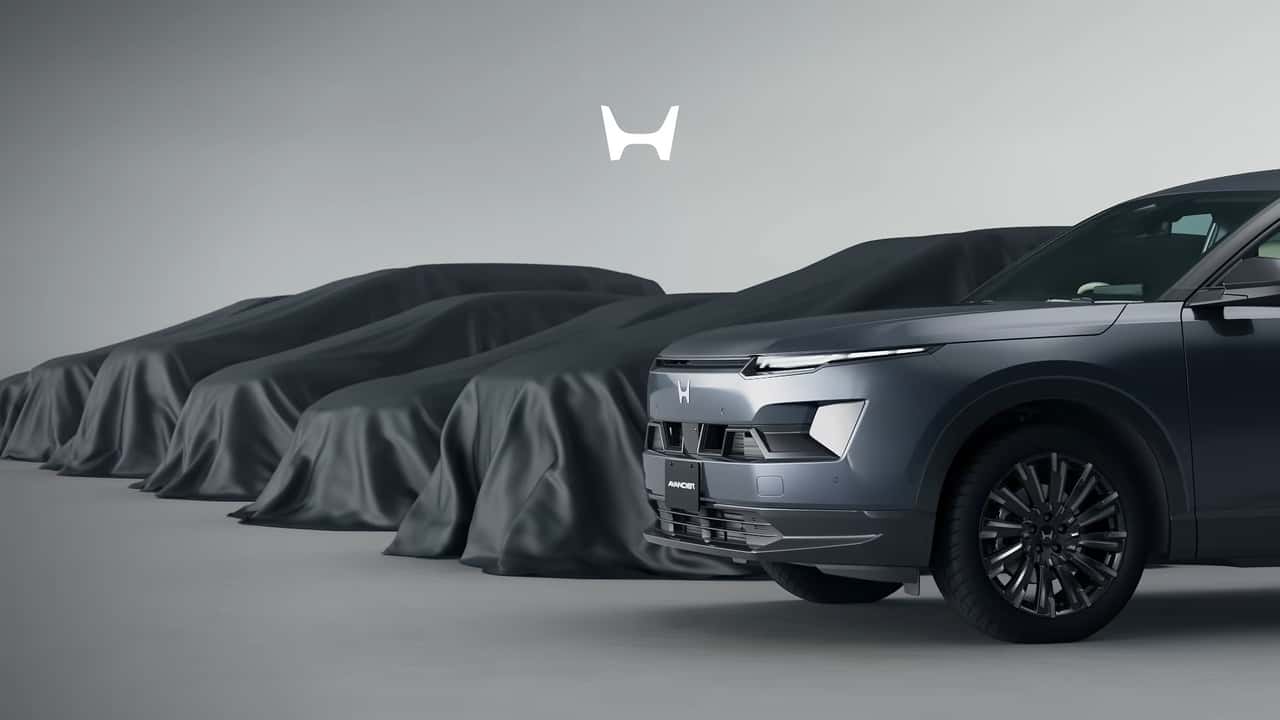
Photo by: Honda
Adrian Padeanu 
By: Adrian Padeanu
Nov 23, at 3:36am ET
Add Motor1.com as a preferred source in Google
- (https://twitter.com/intent/tweet?url=https%3A%2F%2Fwww.motor1.com%2Fnews%2F816386%2Fhonda-teases-new-hybrids-details-new-platform%2F&text=Honda%20Shows%20Several%20New%20Hybrids%20Under%20Covers%2C%20Details%20Modular%20Platform&via=motor1com)
- copy
Share
Comment
Honda's official Avancier video is easy to watch and move on from, and that's exactly how we almost missed what is perhaps even bigger news. In the final seconds, the camera pulls back to show more cars sitting under covers next to the SUV. Honda doesn't say what they are, but the timing makes the message clear: the Avancier is just the first of several new hybrids due from 2027.
What Honda did explain, in a detailed press release, is what's underneath them. A new Honda Hybrid system replaces e:HEV, a shared modular platform spans the C- and D-segments, and a new electric all-wheel-drive setup ditches the propeller shaft. Honda promises 10 percent better efficiency and a 30 percent cut in hybridization costs.
Before anyone gets too excited, note the baselines: efficiency is measured against 2018 models, and the cost reduction is against 2023. This isn't a 10 percent jump over what Honda sells today. Still, how the company gets there is more interesting than the headline.
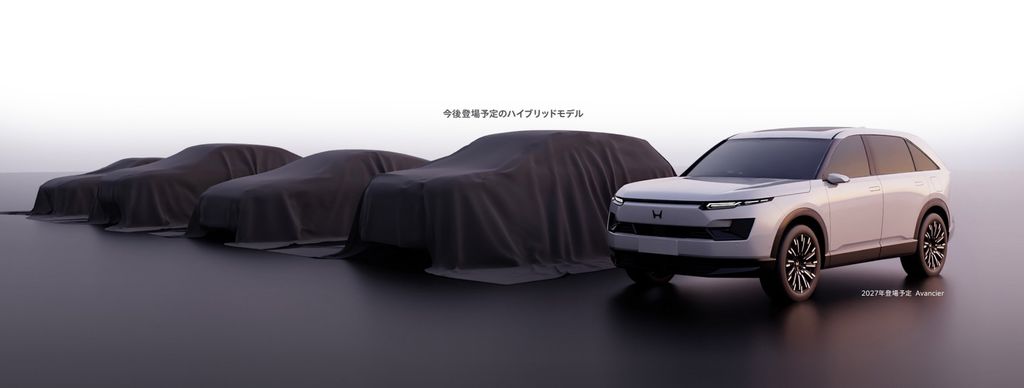
Future Honda hybrid lineup
Photo by: Honda
An Engine That Wants To Run Lean-Free
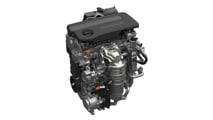
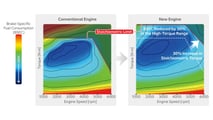
The 2.0-liter engine is built around staying at a stoichiometric air-fuel ratio across the entire operating range. Normally, engines dump extra fuel into the cylinders at high load to keep knocking at bay, which hurts efficiency. Honda's fix is to burn the mixture faster than knock can develop.
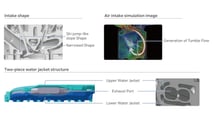
To do that, the intake port is narrowed and given a ski-jump-style ramp that speeds up the airflow and creates strong tumble. The piston crown was reshaped to maintain that tumble, and a two-piece water jacket now cools the exhaust port from both sides. Honda says the stoichiometric torque limit rises 30 percent, fuel consumption in the high-torque region drops 30 percent, and the engine's high-efficiency zone grows by 30 percent.
The engine is now hybrid-only, so Honda stopped compromising the design for gasoline-only applications. That allowed the cylinder block to shed about 900 grams (almost two pounds), and a redesigned crankshaft saves another 500 grams (1.1 pounds). The engine is also tuned to cope with the different fuel grades sold around the world.

Honda Hybrid
Photo by: Honda
Drive Unit: Same Layout, Better Execution
The two-motor drive unit keeps the parallel-axis layout from the 2023 Accord and CR-V, but nearly everything inside has been tweaked. The traction motor uses heavy-rare-earth-free magnets and thinner electrical steel to cut losses, and both motors get new magnetic circuits that use fewer magnets. That should help with cost and supply risk.
The power control unit is 51 millimeters (two inches) shorter and three percent lighter, even though it now houses the inverter for the new rear motor. Honda also merged two separate cooling circuits into one. A flow-shutter valve can stop heat exchange to warm the drive unit faster, reducing friction when cold. The engine's direct-drive gear also lets the car cruise at higher speeds, which Honda says improves top speed, fuel economy, and refinement.
Honda's new platform
Photo by: Honda
One Platform, C-Segment To D-Segment
The new mid-size platform splits the car into five modules joined by three fixed dimensions. It can underpin both SUVs and sedans, from C- to D-segment, with different ground clearances and driving positions. The benefits are mostly about commonality and weight:
- Engine bay: Commonality across the series jumps to about 90 percent, up from about 60 percent on the previous mid-size hybrid. That also saves around 10 kg (22 lbs).
- Battery: The pack now sits under the rear seat in every model. SUVs used to carry it at the tire pan. Honda consolidated two pack designs into one and cut the parts count by about 50 percent. The pack is bolted to the seat rails as a structural element, and moving the weight inside the wheelbase cuts yaw moment of inertia by two percent.
- Spare tire: Because the battery moved, hybrids can finally get a spare tire stored under the floor.
- Steel: The share of high-strength steel (980 MPa) in the body goes from 11.2 to 37.2 percent, with the grade chosen based on what's available in each region.
Honda's new chassis developments
Photo by: Honda
Chassis And Dynamics
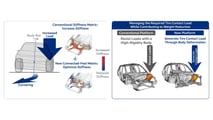
Honda says it is deliberately avoiding an overly stiff body, arguing that too much rigidity reduces the load on the tires. So it is adding stiffness in some areas and letting the structure flex in others to keep the tires planted in corners.
Under the car, the front subframe extension is gone, and the front lower arms and knuckles are aluminum. At the rear, the trailing arms are straightened, and the rear brake calipers move ahead of the axle to cut road noise. Adaptive dampers will be available depending on the market.
The all-wheel-drive system is the biggest change. The mechanical setup with a propeller shaft is replaced by an electric system called DualPower eAWD, which uses a dedicated rear motor. The front and rear are controlled independently so that the system can shift torque quickly under acceleration, braking, and cornering, and it can regenerate at the rear axle as well. Traction control now runs separate loops for front and rear, so a slipping axle doesn't cut power to the one with grip.
Honda Hybrid driving position
Photo by: Honda
Better Driving Position
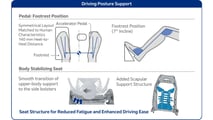
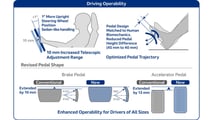
Honda says the new platform's driving position starts from what it calls a skeletal standard. The footrest and accelerator pedal are set 140 mm (5.5 in) apart, a heel-to-heel distance based on human anatomy, and the footrest angle is moved closer to the pedal so both feet sit evenly. There are two footrest angles, one for SUVs and one for sedans.
The steering wheel is now one degree more upright and gains 10 mm (0.4 in) of telescopic travel to reduce elbow bend. The step between the brake and accelerator pedals shrinks from 45 to 40 mm (1.7 to 1.6 in) to make switching easier, and the pedals themselves are bigger. The brake pedal is 10 mm (0.4 in) longer and the accelerator 13 mm (0.5 in) longer, which Honda says fixes a lack of pedal-top length for tall drivers and gives smaller drivers more contact area.
What do you think?
View
Comments
The seat and suspension are part of the same effort. Honda tuned the suspension so the car's roll matches the movement of the front occupants' bodies, then added shoulder-blade support to the Body Stabilizing Seat it introduced on the 2020 Fit. The idea is to reduce how much occupants have to brace against the car's motion, which cuts muscle effort and fatigue on long drives.
Looking ahead, Honda has committed to launching 15 next-generation hybrid models globally by the end of its fiscal year on March 31, 2030.
Honda new modular platform and battery for hybrids
17
Source: Honda
We want your opinion!
What would you like to see on Motor1.com?
Take our 3 minute survey.
- The Motor1.com Team
Share this Story
- (https://twitter.com/intent/tweet?url=https%3A%2F%2Fwww.motor1.com%2Fnews%2F816386%2Fhonda-teases-new-hybrids-details-new-platform%2F&text=Honda%20Shows%20Several%20New%20Hybrids%20Under%20Covers%2C%20Details%20Modular%20Platform&via=motor1com)
- copy
GO TO COMMENTS
(
)
Got a tip for us? Email: tips@motor1.com
View all comments ( )
Popular
BYD Better Watch Out: Koenigsegg Is Still Chasing A 330-MPH Jesko Run
BYD's Boxy SUV Banned In The EU After Land Rover Defender Copycat Ruling
Honda Shows Several New Hybrids Under Covers, Details Modular Platform
Audi Has 7 New Models Coming In 2027. Here's All Of Them
Latest Stories
- Honda Shows Several New Hybrids Under Covers, Details Modular Platform Nov 23 - Teasers -
- Steve McQueen's Ferrari NART Spider Just Sold For $18.9 Million Nov 23 - For Sale -
- Stellantis Reportedly Pulling The Plug On All Motorsport Programs Nov 23 - Motorsport -
- BYD Puts A Folding Steering Wheel Into Production Nov 23 - Technology -
- BYD Better Watch Out: Koenigsegg Is Still Chasing A 330-MPH Jesko Run Nov 23 - Supercars -
- Child Car Seats Expire Even If They Look Perfectly Fine. Here's Why Nov 22 - Motor101 -
- Every New Car Has A Sticker Most Buyers Don't Know By Its Real Name Nov 22 - Motor101 -
RECOMMENDED FOR YOU
Honda Debuts New Three-Row SUV With Next-Gen Hybrid Technology
Steve McQueen's Ferrari NART Spider Just Sold For $18.9 Million
Over 1 Million Honda And Acura Vehicles Face Start/Stop Failure That Could Leave Drivers Stranded
Stellantis Reportedly Pulling The Plug On All Motorsport Programs
12 Cars That Should Easily Make It To 250,000 Miles
BYD Puts A Folding Steering Wheel Into Production
Next Honda CR-V Is Going Hybrid-Only. Here's The First Teaser