Home
Nissan
News
Nissan Turns Discarded Pineapple Leaves Into High-Performance Car Parts
Pineapple-leaf fibers become flat yarn and woven fabric as Nissan licenses its composite know-how to FOOD REBORN for exhibition panels.
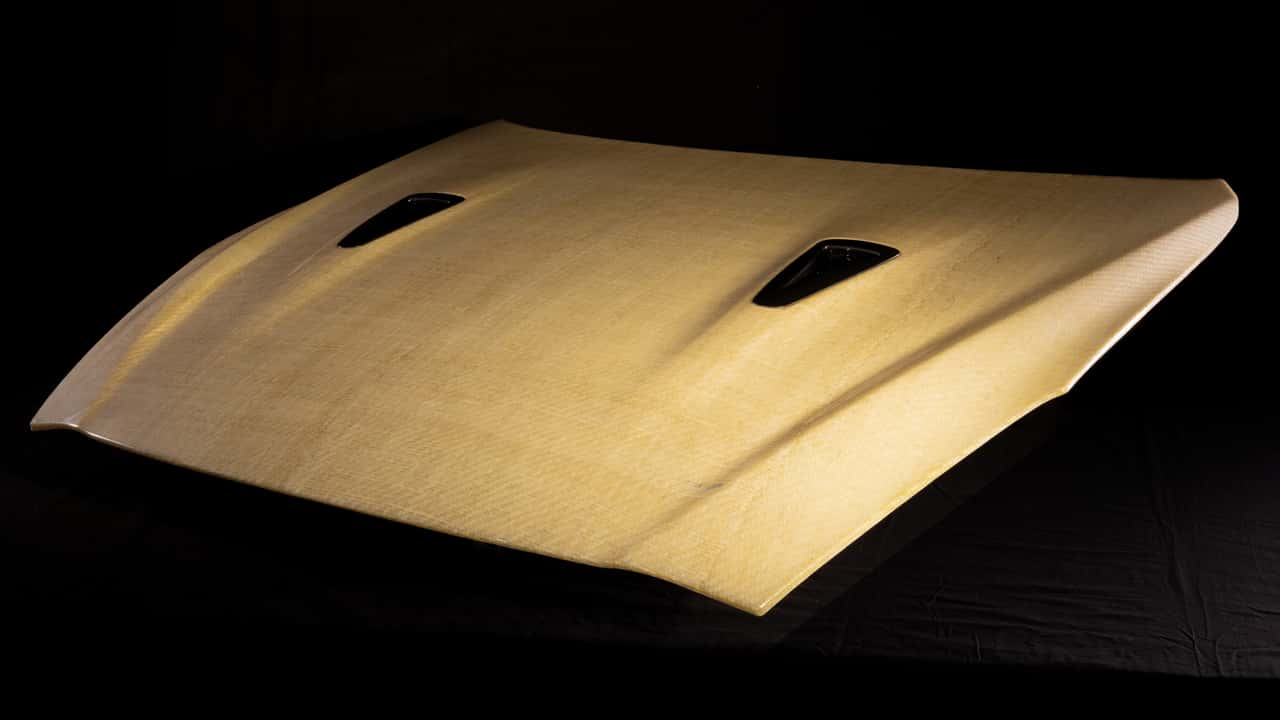
Photo by: Nissan
Brian Potter 
By: Brian Potter
Nov 17, at 7:08am ET
Add Motor1.com as a preferred source in Google
- (https://twitter.com/intent/tweet?url=https%3A%2F%2Fwww.motor1.com%2Fnews%2F815733%2Fnissan-pineapple-leaf-composite-panel%2F&text=Nissan%20Turns%20Discarded%20Pineapple%20Leaves%20Into%20High-Performance%20Car%20Parts&via=motor1com)
- copy
Share
Comment
Nissan and a Japanese materials company, Food Reborn Co. Ltd., just found a second life for agricultural waste. The two firms jointly developed automotive exterior body panels made from natural fiber-reinforced plastic, using fibers pulled from discarded pineapple leaves.
Nissan announced the material on November 17, 2026, a day before it goes on public display. The Yokohama-based automaker says the panel is built for demanding environments, including motorsports, where sustainable composites are typically scarce and costly.
Tatsuzo Tomita, Nissan's corporate executive responsible for technology development said:
'We have developed a new fiber-reinforced composite material that utilizes pineapple leaves, a byproduct usually unutilized and discarded. This sustainable and composite material also delivers the high level of performance required for demanding environments such as motorsports.'
Pineapple-Fiber Body Panel

Nissan Natural Fiber-Reinforced Plastic Exterior Body Panels
Photo by: Nissan
The panel pairs pineapple-leaf fiber with resin to form a natural fiber-reinforced plastic, the same broad category of material some racing series already require for modified exterior body panels. Supply of those composites, Nissan notes, has long been limited and expensive.
Nissan says the finished material offers higher tensile strength than conventional natural-fiber composites built on flax. BMW uses flax-based composites in motorsport and in the M Concept Neue Klasse, the design study that previews its first fully electric M car. Nissan hasn't released test data to let the comparison be checked independently.
Etsuko Uda, representative director and CEO of Food Reborn, built the project around what pineapple farming throws away. She said:
'Transforming agricultural byproducts like pineapple leaves into high-performance materials for automotive and sporting goods is highly significant. Driven by deep conviction, we remain dedicated to unlocking new possibilities.'
Worldwide, farmers discard more than 50 million tons of pineapple leaves every year. That volume gives the partnership plenty of raw material to draw from without touching food production.
Nissan ties the work to its broader push to build more interesting cars, under its Green Program 2030 sustainability targets.
Gallery: Nissan Natural Fiber-Reinforced Plastic Exterior Body Panels
14






Source: Nissan
Turning Pineapple Leaves Into Reinforced Plastic
The manufacturing process has several steps. Fibers extracted from the leaves get spun into flat yarn, the yarn is woven into fabric, and that fabric becomes the reinforcement layer inside the composite before it is molded into a body panel shape.
Under the arrangement, Nissan licenses its natural fiber-reinforced-plastic know-how to Food Reborn, covering flat yarn, woven fabric and resin-impregnated prepreg production. Food Reborn is based in Okinawa and set to mark its tenth anniversary in September 2027.
The company specializes in biodegradable materials and brings its own experience handling pineapple-leaf fibers.
What do you think?
View
Comments
Nissan hasn't said whether this composite will reach a production road car. The current panel exists as exhibition technology, and the company hasn't published a lifecycle assessment or a quantified carbon-footprint figure for the material yet.
The hood will be shown publicly at the SAMPE Japan Advanced Materials Technology Exhibition 2026, running November 18 through 20 at Tokyo Big Sight's East Hall. Nissan and Food Reborn will share a booth there, alongside the industry group and trade newspaper that organize the annual event.
More On New Materials:
Jeremy Clarkson Is Growing A Jaguar F-Type On His Farm
Bentley’s New EV Uses 100% Merino Wool—Not Leather
Renault develops recycled upholstery for new Zoe electric hatchback
Car interiors are becoming more eco-friendly
Source: Nissan
We want your opinion!
What would you like to see on Motor1.com?
Take our 3 minute survey.
- The Motor1.com Team
Share this Story
- (https://twitter.com/intent/tweet?url=https%3A%2F%2Fwww.motor1.com%2Fnews%2F815733%2Fnissan-pineapple-leaf-composite-panel%2F&text=Nissan%20Turns%20Discarded%20Pineapple%20Leaves%20Into%20High-Performance%20Car%20Parts&via=motor1com)
- copy
GO TO COMMENTS
(
)
Got a tip for us? Email: tips@motor1.com
View all comments ( )
Popular
BMW Has 10 New Models Coming In 2027. Here's All Of Them
Driven: BMW's Electric M3 Is The Real Deal
Porsche Revisits Its Strange Car Designed To Last 20 Years
Where Did All The Bad Cars Go?
I Tried Mercedes' New Hands-Free Driving Tech. It Nearly Drove Me Everywhere
Latest Stories
- Nissan Turns Discarded Pineapple Leaves Into High-Performance Car Parts Nov 17 - Technology -
- A Waymo Robotaxi Tried To Pass Police Cars. It Didn't Go Well Nov 17 - Autonomous Vehicles -
- Porsche Revisits Its Strange Car Designed To Last 20 Years Nov 17 - Concept Cars -
- 2028 Ford Mustang GTD Gets A Special Edition 125 Years In The Making Nov 17 - Special Editions -
- This Kia Stinger V6 Filled With Metal After 100,000 Miles Nov 17 - Engines -
- A Chinese Company Is Reproducing Classic Car Bodies On The Cheap Nov 17 - Classics -
- A $1.6 Million McLaren Senna Couldn't Find A Buyer. Now It's Sitting Neglected Nov 17 - Supercars -
RECOMMENDED FOR YOU
A Chinese Company Is Reproducing Classic Car Bodies On The Cheap
A Waymo Robotaxi Tried To Pass Police Cars. It Didn't Go Well
12 Crossovers That Are Surprisingly Good At Off-Roading
Porsche Revisits Its Strange Car Designed To Last 20 Years
The Nissan Patrol Is Finally Back in America. Sort Of
2028 Ford Mustang GTD Gets A Special Edition 125 Years In The Making
Is Body-On-Frame Really Better For Off-Roading?