Disney Is Testing 'Cars' Robots To Help You Find A Parking Spot
Field AI and Walt Disney Imagineering built a four-wheeled prototype that waves, flashes, and displays signs to guide drivers into open spaces.
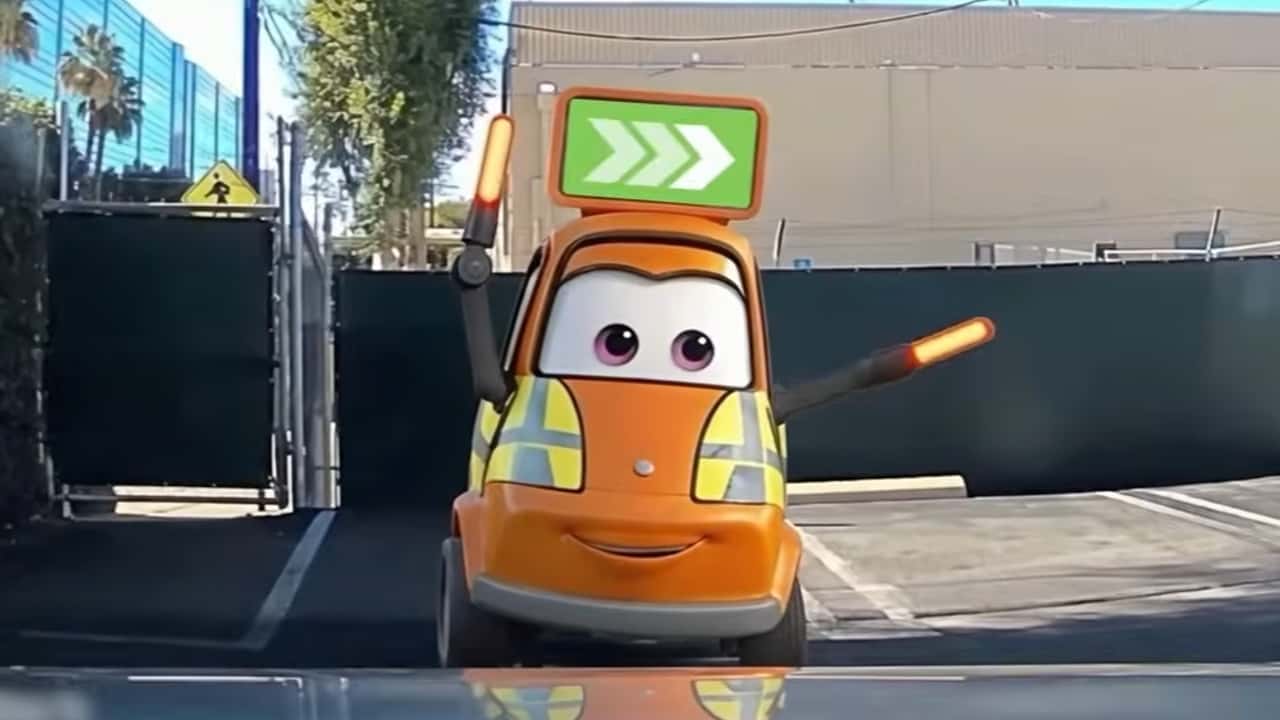

Disney has a new hire that does not need a name tag: a four-wheeled robot with animated eyes, glowing arms, and a job directing cars into empty parking spots. The prototype showed up at Disney Accelerator Demo Day, built with Irvine robotics firm Field AI.
Field AI was founded in 2023 by former engineers from Google DeepMind, NASA, Nvidia, and Tesla. The company built the parking assistant alongside Walt Disney Imagineering to see how the robots perform and how people react to them.
Disney's AI Parking Robots Are Still Experimental

'Cars' AI-Powered Parking Assistant Robot
Disney has not provided a deployment timeline for the Field AI parking assistants and has not guaranteed they will ever show up at Disneyland's parking facilities.
Disneyland officials went further, telling reporters there are no current plans to launch the technology shown at the demo day. This was a proof of concept only.
The Field AI project was not alone on stage. It appeared alongside four other companies at Disney Accelerator Demo Day 2026, a program the resort uses to test outside tech before deciding whether any of it belongs in its amusement parks.
For context on how experimental robotics ideas eventually reach real driveways, Tesla has run its own public tests with autonomous vehicle demonstrations in Texas. However, that program sits in a different category entirely from a parking-lot attendant robot.
Cars-Inspired Robot Uses Signs, Screens, And Lights
'Cars' AI-Powered Parking Assistant Robot
The demonstrated robot makes full use of its Pixar inspiration. It carries a large front-mounted screen that mimics a windshield, complete with animated eyes and moving eyelids, built to resemble the self-driving food delivery robots already rolling around some US sidewalks.
A roof-mounted sign changes its message to point drivers toward open spaces, functioning like a mobile, car-shaped version of the static directional signs already common in resort lots. The robot wears its Cars and WALL-E styling on the outside instead of hiding the tech behind a plain shell.
Two small arms finish the design, each fitted with red lights, waved at approaching drivers the way an aircraft marshaller signals a plane into its gate. The screen, the sign, and the arms give the robot three separate ways to talk to a driver who has never seen it before.
That layered approach to human-robot communication is not unique to Disney. Automakers working on driver assistance systems for production vehicles face a similar problem: how a machine signals intent to a person who has to trust it in real time, whether that is a car merging in traffic or a robot waving someone into a space.


More On Cars:
Source: Disney via Press Enterprise
RECOMMENDED FOR YOU
The Manual C8 Corvette Is Real, And Really Expensive
They Spent Eight Years Building A Lancia Stratos. Now They Can Finally Drive It
Older Bentley Models Get Apple CarPlay And Android Auto Thanks To New Infotainment Upgrade
Honda Recalls More Than 635,000 Vehicles Over Potential Power Steering Failure
Ford: Mustang Mach-E Batteries Age Better Than Expected
Want A Deal On A Used Car? Wait Until Winter: Study
Mercedes Was 'Too Early' On Hands-Free Driving. Now It's Taking A Step Back