Home
Bugatti
Tourbillon
News
Bugatti’s 1,800-HP Tourbillon Shrugs Off Scorching Heat
Engineers push the Bugatti Tourbillon through Spain, Dubai, and Sweden to prove its cooling, climate control, and hybrid systems work in brutal conditions.
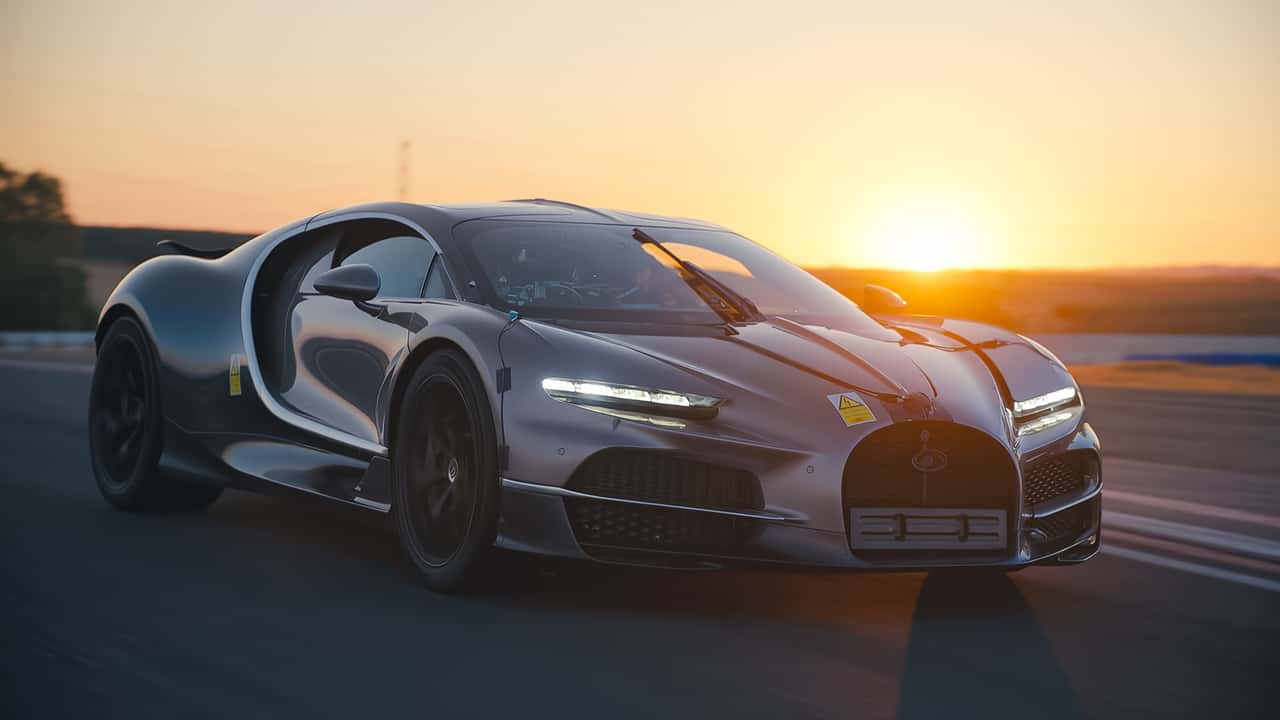
Photo by: Bugatti
Brian Potter 
By: Brian Potter
Oct 12, at 2:38am ET
Add Motor1.com as a preferred source in Google
- (https://twitter.com/intent/tweet?url=https%3A%2F%2Fwww.motor1.com%2Fnews%2F811519%2Fbugatti-tourbillon-extreme-hot-cold%2F&text=Bugatti%E2%80%99s%201%2C800-HP%20Tourbillon%20Shrugs%20Off%20Scorching%20Heat&via=motor1com)
- copy
Share
Comment
Bugatti has a new episode in its "A New Era" documentary series, and this one is about heat, not snow. The development team took the Tourbillon to Seville, where track and road temperatures climbed past 45°C (113°F), to see whether the hypercar's cooling systems could keep both the powertrain and the cabin under control.
The Tourbillon pairs a naturally aspirated V16 with three electric motors for a combined 1,800 horsepower. Two of the motors sit on the front axle, with a third backing up the V16 at the rear, and an 800V battery ties it all together. That architecture generates a thermal load Bugatti needed to prove it could manage without reshaping the car's bodywork.
Spain Testing Puts Cooling And Climate Control Under Pressure

Bugatti Tourbillon (2026) in southern Spain
Photo by: Bugatti
The Spanish test program followed earlier validation runs in Dubai and Sweden. Together they round out a climate trial meant to expose weaknesses before customer cars reach the road. More than 200 thermocouples were wired through the prototype to track how individual zones responded as the car moved between environments.
Daniel Ríos Hidalgo, a vehicle development engineer at Bugatti Rimac, said the goal was cooling the cabin and engine bay without compromising the car's shape. "In order not to compromise the shape and the design, we have very clever cooling circuits and cooling systems inside the car to make sure that all the systems remain under controlled temperatures," he said.
Paolo Magrone, a vehicle development driver at Bugatti Rimac, said performance came ahead of comfort for its own sake. "When you have a lot of power but you don't feel comfortable on the track or on the road, it's very difficult to be precise," he said, adding that keeping the cabin cool lets owners "enjoy the car at its best." The Tourbillon's interior was engineered with that same priority in mind, long before the Seville heat tested it.
Bugatti ran the car on both public roads and a racetrack to separate two different stresses. Open roads reached around 45°C (113°F), mimicking what an owner might face in a hot climate. The track piled on sustained loads across tires, brakes, powertrain and cooling systems all at once.
Gallery: Bugatti Tourbillon (2026) in Southern Spain
12






Source: Bugatti
Tourbillon Has Already Faced 122-Degree Heat And Bitter Cold
Spain wasn't the first extreme the Tourbillon has seen. About 15 months earlier, an XP prototype was pushed through Dubai heat exceeding 50°C (122°F), long before the more refined validation cars arrived in Seville for this latest round.
On the opposite end, Bugatti ran winter testing in Arjeplog, Sweden, where temperatures dropped to -30°C (-22°F). That program concentrated on low-grip handling, braking and stability systems, plus whether the cabin could stay livable in severe cold.
What do you think?
View
Comments
"We are delivering cars all over the world," Ríos Hidalgo said. "We have customers from lots of places that are going to drive the cars in different conditions. We need to make sure that these cars perform properly in all these varieties of conditions." Bugatti treats the hot and cold programs as complementary halves of the same validation effort, each confirming the car behaves consistently once simulation meets real pavement.
All 250 Tourbillon units are already sold, with deliveries beginning in 2026 and the final car expected to reach its owner by 2029. Bugatti plans to build roughly 80 cars a year at its La Manufacture facility in Molsheim, with pricing starting at €3.8 million ($4.26 million) before taxes.

More From Bugatti:
Bugatti Gets It: Screens Are Not Luxury
Bugatti Veyron Wimille Smashes Auction Record At $5.44 Million
It's Over: Bugatti Is No Longer Part Of The Volkswagen Group
Bugatti Says No To Fake Engine Sounds, Yes To 'Dirty And Raw' V16 Notes
Source: Bugatti
We want your opinion!
What would you like to see on Motor1.com?
Take our 3 minute survey.
- The Motor1.com Team
Share this Story
- (https://twitter.com/intent/tweet?url=https%3A%2F%2Fwww.motor1.com%2Fnews%2F811519%2Fbugatti-tourbillon-extreme-hot-cold%2F&text=Bugatti%E2%80%99s%201%2C800-HP%20Tourbillon%20Shrugs%20Off%20Scorching%20Heat&via=motor1com)
- copy
GO TO COMMENTS
(
)
Got a tip for us? Email: tips@motor1.com
View all comments ( )
Popular
BMW Has 10 New Models Coming In 2027. Here's All Of Them
Driven: BMW's Electric M3 Is The Real Deal
GM Might Finally Build A Real F-150 Raptor Rival: Report
Where Did All The Bad Cars Go?
I Tried Mercedes' New Hands-Free Driving Tech. It Nearly Drove Me Everywhere
Latest Stories
- Driven: BMW's Electric M3 Is The Real Deal Nov 16 - First Drives -
- What Is A Solid-State Battery, And Why Is Everyone Talking About It? Nov 16 - Motor101 -
- Maserati: Our Cars Don't Need Wild Styling To Stand Out Nov 16 - Design -
- GM Might Finally Build A Real F-150 Raptor Rival: Report Nov 16 - Rumors -
- Diesel Engines Make More Torque Than Ever, And It's Not An Accident Nov 16 - Motor101 -
- New Hyundai Elantra N Caught Testing, And It Looks Spicy: Video Nov 16 - Spy Shots -
- There's A New James Bond Nov 16 - Breaking -
RECOMMENDED FOR YOU
The Average Bugatti Buyer Is Just 42 Years Old. One Customer Owns 14 Of Them
What Is A Solid-State Battery, And Why Is Everyone Talking About It?
Spyker Wants To Beat Bugatti And Pagani: 'We Will Position Ourselves At The Very Top'
Maserati: Our Cars Don't Need Wild Styling To Stand Out
From Detroit To Tokyo: Where Every Major Automaker Calls Home
GM Might Finally Build A Real F-150 Raptor Rival: Report
Bugatti Celebrates 20 Years In America With A Spectacular Las Vegas Gathering