Home
News
Technology
You Don’t Need Speed To Feel A Thrill, Science Explains Why
Castrol research with Brainbox tracks brain waves, heart rate, skin response and eye movement to pinpoint when driving feels thrilling instead of scary.
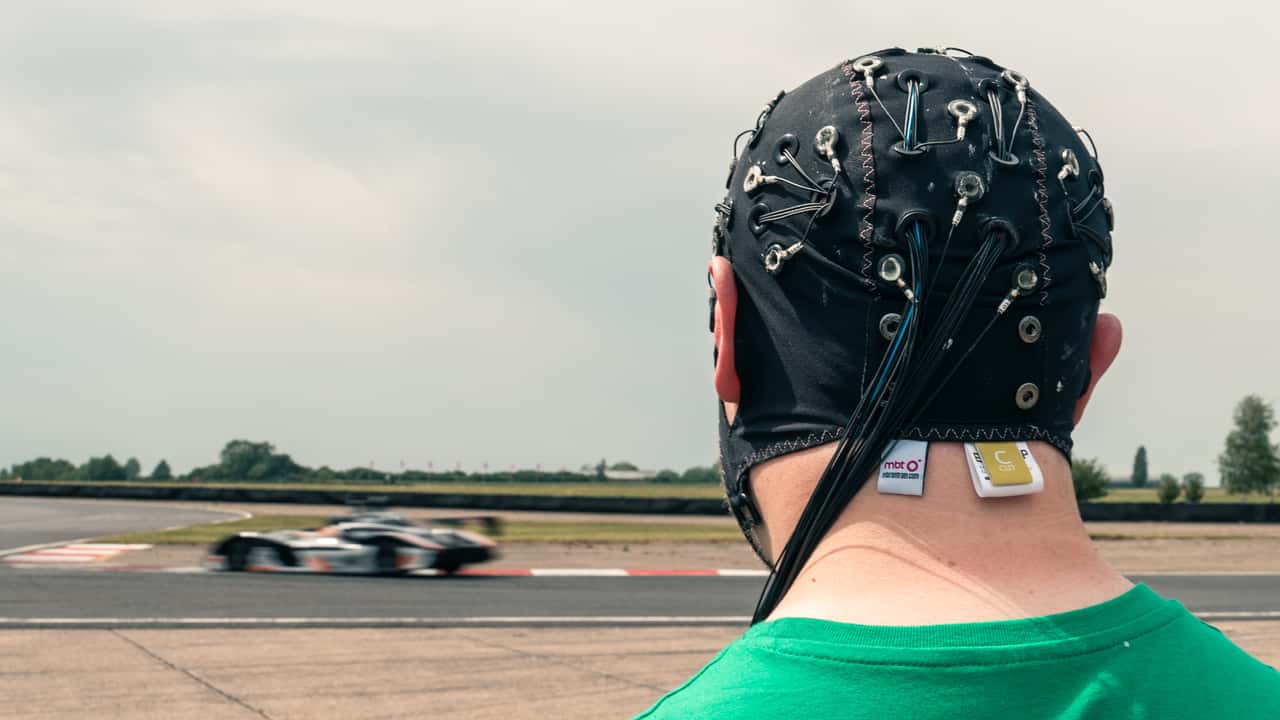
Photo by: Castrol
Brian Potter 
By: Brian Potter
Aug 24, at 7:44am ET
Add Motor1.com as a preferred source in Google
- (https://twitter.com/intent/tweet?url=https%3A%2F%2Fwww.motor1.com%2Fnews%2F805880%2Fcastrol-driving-thrill-study%2F&text=You%20Don%E2%80%99t%20Need%20Speed%20To%20Feel%20A%20Thrill%2C%20Science%20Explains%20Why&via=motor1com)
- copy
Share
Comment
THE BREAKDOWN
- Castrol and Brainbox found thrill needs three peaks at once: physical stimulation, cognitive engagement, and excitement winning out over fear.
- A McLaren Artura GT4 session produced the strongest thrill signature.
- Riding as a passenger in the JPLM produced fear signatures.
Castrol has published a brain-and-body study on driving that tries to pin down why some laps feel electric while others just feel quick. The company wired up drivers with brain, eye, heart, and skin sensors across five closed-course runs, then had UK-based neuroscience firm Brainbox sift the data to separate thrill from fear.
The main takeaway cuts across a common assumption in the car world: speed by itself does not guarantee a thrill. Castrol says the sweet spot comes when three things crest together: a jolt of physical stimulation, a demanding mental task, and an emotional state where excitement edges out fear.
Gallery: Castrol Study: Thrill Of Driving

5

Source: Castrol
How The Study Measured "Thrill"
Participants drove or rode through five scenarios at the PalmerSport facility in Bedfordshire, England, all with instructors and away from public roads. The lineup ran from slow off-roading in a Land Rover Defender to single-seat karts, a McLaren Artura GT4 race car, an open-wheel JPLM car, and a JPLM ride-along with a professional at the wheel.
Brainbox tracked four streams of data: 30-channel brain-wave readings, heart rate variability, skin conductance, and eye tracking that logged fixations, blink rate, and saccades. On their own, none of these signals cleanly separated excitement from anxiety, but cross-referenced together they did a better job of flagging true thrill states.
The McLaren Artura GT4 laps showed the clearest thrill pattern. Drivers locked their gaze on the racing line for an average of 70 apex-focused fixations per minute and blinked only 2.5 times per minute, compared with 15 to 20 blinks at rest. Average heart rate climbed by 43.8 beats per minute in the McLaren and 16 beats per minute on the off-road course.
Castrol Thrill of Driving - Subject in McLaren
Photo by: Castrol
Why The Passenger Seat Felt Like Fear, Not Fun
The sharpest split between thrill and fear came in the JPLM passenger test, where a professional pushed the car while participants rode along. Brain readings showed more fast beta waves linked with stress, while the focus-related theta and calming alpha activity that rose during the McLaren and karting sessions dropped away.
Eye tracking matched that story. In the JPLM ride-along, participants averaged 40 blinks and 190 fixations per minute while cornering, against the 2.5 blinks and 70 fixations logged in the McLaren. Karting at modest speeds on a tight circuit scored higher on thrill than the high-speed passenger run, and the 5 mph off-road course still outranked the ride-along.
Brainbox co-founder Dan Phillips argues that the most intense thrill shows up when arousal, control, and immersion spike together. In that reading, thrill is less about top speed and more about locking in on the task, which shows up across brain activity, heart rate, and eye behavior.
What do you think?
View
Comments
Head of Product and Communications for Castrol Europe, Vincent Panel, points to the results as evidence that drivers can find a similar sense of control at a karting track or on a favorite back road, not just in a supercar at triple-digit speeds.
Motor1's Take: Treat the results as a useful hint, not a final word. These were controlled tests with pros on private circuits, so they do not mirror daily commuting. The interesting next step is broader, real-world work or future experiments that use similar brain and body signals to shape safer, more engaging everyday driving.
More Studies:
Car Buyers Don’t Want More Tech. They Just Want Heated Seats
Lexus Is No Longer The King Of Initial Quality. This Brand Beat It
These Drivers Are Getting Hit Hardest By Fuel Costs: Study
The Auto Industry Is Realizing That Selling Your Data Isn’t Worth It: Study
Source: Castrol
We want your opinion!
What would you like to see on Motor1.com?
Take our 3 minute survey.
- The Motor1.com Team
Share this Story
- (https://twitter.com/intent/tweet?url=https%3A%2F%2Fwww.motor1.com%2Fnews%2F805880%2Fcastrol-driving-thrill-study%2F&text=You%20Don%E2%80%99t%20Need%20Speed%20To%20Feel%20A%20Thrill%2C%20Science%20Explains%20Why&via=motor1com)
- copy
GO TO COMMENTS
(
)
Got a tip for us? Email: tips@motor1.com
View all comments ( )
Popular
BYD Better Watch Out: Koenigsegg Is Still Chasing A 330-MPH Jesko Run
12 Underrated Performance Cars That Nobody Bought
Honda Shows Several New Hybrids Under Covers, Details All-New Modular Platform
Driven: New Audi Q7 And SQ7 Bring The Power And The Tech
Audi Has 7 New Models Coming In 2027. Here's All Of Them
Latest Stories
- Infiniti's New Manual Sports Sedan Could Bring Back A Beloved Name Nov 23 - Rumors -
- 12 Underrated Performance Cars That Nobody Bought Nov 23 - Lists -
- Hyundai Isn't Giving Up On Sedans Nov 23 - Manufacturing / Production -
- This Corvette Sat Abandoned For 25 Years. Then It Got Its First Deep Clean Nov 23 - Classics -
- Driven: New Audi Q7 And SQ7 Bring The Power And The Tech Nov 23 - New Car Reviews -
- Subaru's American-Built Ascent Is Heading To Japan Nov 23 - Official -
- Rare Ferrari 499P Modificata Rear-Ends Schumacher-Era F1 Car Nov 23 - Crashes / Wrecks -
RECOMMENDED FOR YOU
Audi Drivers Can Now Manage Emails And Teams Meetings Using AI
12 Underrated Performance Cars That Nobody Bought
BYD Puts A Folding Steering Wheel Into Production
Hyundai Isn't Giving Up On Sedans
Lamborghini Temerario Spyder Gets Apple Vision Pro Immersive 3D Experience
This Corvette Sat Abandoned For 25 Years. Then It Got Its First Deep Clean
Mercedes Admits It Went Too Far With Screens. But Says Digital Controls 'Still Feel Right'