Home
News
Industry
Electric car market in Europe: growth of 2.1 per cent
Decline in Germany, but the situation is much better in other countries

By: Stefan Leichsenring
Published by: Brian Potter
Jun 23, 2024 at 3:03am ET
Add Motor1.com as a preferred source in Google
- (https://twitter.com/intent/tweet?url=https%3A%2F%2Fwww.motor1.com%2Fnews%2F724206%2Felectric-car-market-europe-up%2F&text=Electric%20car%20market%20in%20Europe%3A%20growth%20of%202.1%20per%20cent&via=motor1com)
- copy
Share
Comment
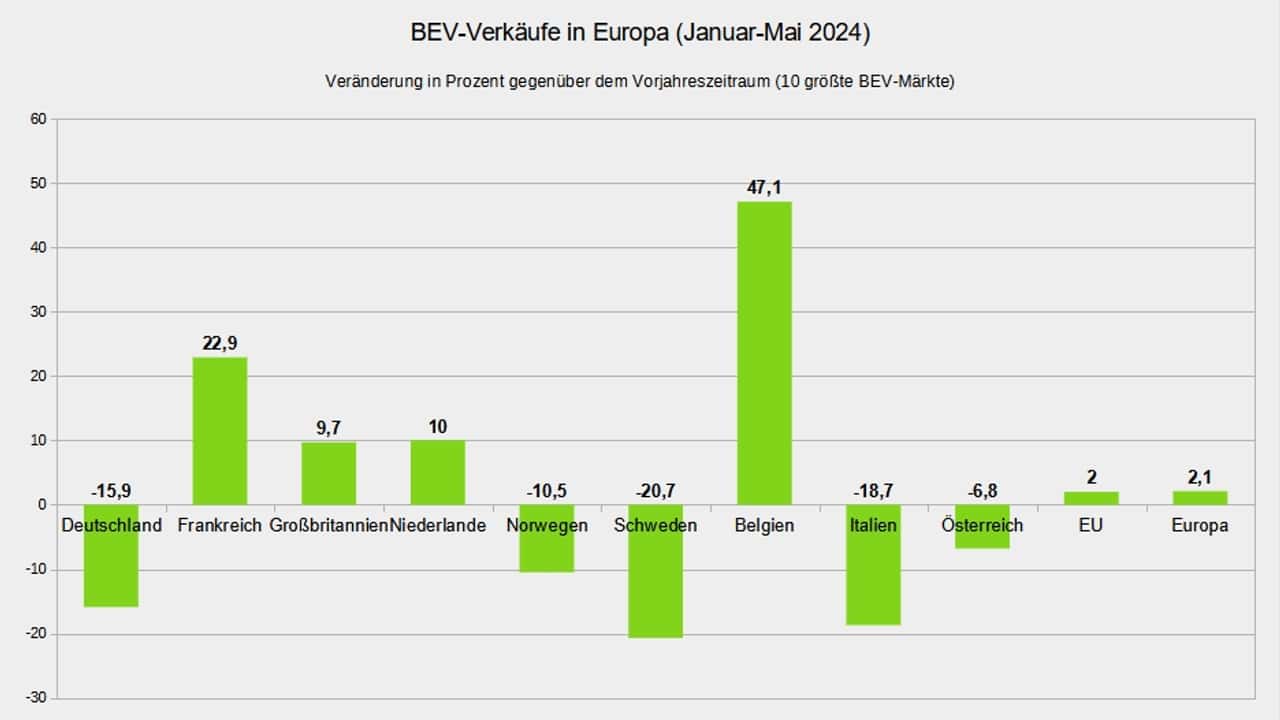
Everyone is talking about the slump in electromobility. In fact, sales figures in Germany have fallen by 16 per cent in the last five months, with Italy even worse off at minus 19 per cent. However, the picture in the rest of Europe is much more positive.
France, for example, recorded an impressive increase of 23 per cent, while the UK was up 10 per cent - see our chart above. Overall, the market in the EU grew by two per cent to around 556,000 units, and in Europe (EU plus EFTA plus the UK) by 2.1 per cent to 745,000 units. The share of battery electric vehicles (BEVs) was 11.9 per cent across the EU and 13.1 per cent across Europe. For comparison: in Germany, the BEV share was 12.0 per cent. All of these figures relate to the months of January to May 2024 compared to the same period in the previous year and come from the European Automobile Manufacturers' Association ACEA.
The fact that France performed so well was probably due to the new subsidy - up to €7,000 from the state, as reported by the Frankfurter Allgemeine Zeitung. In Germany, on the other hand, the environmental bonus was surprisingly reduced to zero at very short notice in December. The situation is apparently similar in Italy although the government there announced a subsidy, the specific form it would take remained unclear for months. A poor subsidy policy is also likely to have increased customer uncertainty about electric mobility.

BEV sales in Europe from January to May 2024 (absolute figures)
Our figures do not show the largest European countries, but those with the highest electric car sales. This is why Spain, which lagged behind the much smaller Austria with only 18,000 BEVs sold, is missing. Other small countries such as the Netherlands, Norway, Sweden and Belgium are also far ahead, while Italy, with its large population, is just ahead of Austria in the top ten. Eastern European countries such as Poland, Hungary and the Czech Republic also have low sales figures.
Incidentally, the absolute figures for Germany differ from the KBA figures; for January to May, the KBA recorded around 141,000 cars, while the ACEA recorded 167,000 BEVs. This is probably due to the fact that the ACEA figures are sales figures, while the figures from the Federal Motor Transport Authority are registration figures.
Speaking of statistical subtleties, we generally don't think much of evaluating the sales figures for a single month - there are too many factors involved, even the number of working days. That's why we generally only write about reasonably long periods, such as January to May. If you take just one month - like May, for example - you end up with headlines like "Europeans hold back on e-car sales" (FAZ). That's not entirely wrong, but we don't think it's quite right either when a 2 per cent increase is recorded from January to May.
Read also:
UK: 15 highest depreciating used cars under £15,000 unveiled
These are the world's best-selling cars: The definitive rankings for 2023
The bottom line
What do you think?
View
Comments
Is there a slump in electromobility? Well, slump is a strong word. The only stronger word is crash. In Germany, the drop is 16 per cent, which we would describe as a severe slump. We would talk about a slump at minus 40 per cent, and a crash at minus 80 per cent. But let's stop quibbling with words.
As bad as the minus in Germany is, the picture is brightened by the significant growth in France and the plus in the UK. The drop in Italy is not so significant from a European perspective because sales figures are low here anyway. Electric car sales are likely to pick up again in 2025 anyway, as stricter CO2 fleet limits will then apply: If sales of BEVs are low again next year, manufacturers will either have to lower BEV prices or pay a fine to the authorities.
Sources: ACEA-Tabelle (PDF), FAZ.net (Paywall)
We want your opinion!
What would you like to see on Motor1.com?
Take our 3 minute survey.
- The Motor1.com Team
Share this Story
- (https://twitter.com/intent/tweet?url=https%3A%2F%2Fwww.motor1.com%2Fnews%2F724206%2Felectric-car-market-europe-up%2F&text=Electric%20car%20market%20in%20Europe%3A%20growth%20of%202.1%20per%20cent&via=motor1com)
- copy
GO TO COMMENTS
(
)
Got a tip for us? Email: tips@motor1.com
View all comments ( )
Popular
12 Cars With Names That Make Absolutely No Sense
BMW Kept This Hatchback A Secret For Decades
Bugatti Restores One-Off Veyron With A Mirror-Like Aluminum Body
The Gas BMW M3 Isn't Dead: Next-Gen Prototype Roars
latest articles
- Subaru Built A 510-HP Electric Wagon Without Toyota's Help Oct 20 - Official -
- The Strange Reason The Golf GTI Had A Golf Ball Shifter Oct 20 - Motor101 -
- Photos: Porsche's Mission S Concept Takes Over New York City Oct 20 - Design -
- The 2027 Honda Passport TrailSport Looks Noticeably Taller Next To Last Year's Model Oct 20 - Off-Road -
- 12 Cars With Names That Make Absolutely No Sense Oct 20 - Lists -
- The Ford Ranger Is Getting A Bigger V6 For 2027: Report Oct 20 - Rumors -
- BMW Already Has A Deal On The New i3. But It's Not Cheap Oct 20 - Pricing -
RECOMMENDED FOR YOU
Lincoln Will Have Fewer Than 300 Dealerships By The End Of 2027
The Ford Ranger Is Getting A Bigger V6 For 2027: Report
Mercedes Admits It Underestimated The V8 Crowd, Teases A V12 Surprise
BMW Already Has A Deal On The New i3. But It's Not Cheap
The Best (And Worst) Cities For Owning An EV: Study
Remember The Ford Flex? This Weird SUV Is Now A Great Used Buy
Jaguar Explains Why It Had To Kill All Gas Cars