Home
Features
Opinion
Where Did All The Bad Cars Go?
Between stricter regulations, better technology, and higher expectations, even today's cheapest cars are still pretty good.
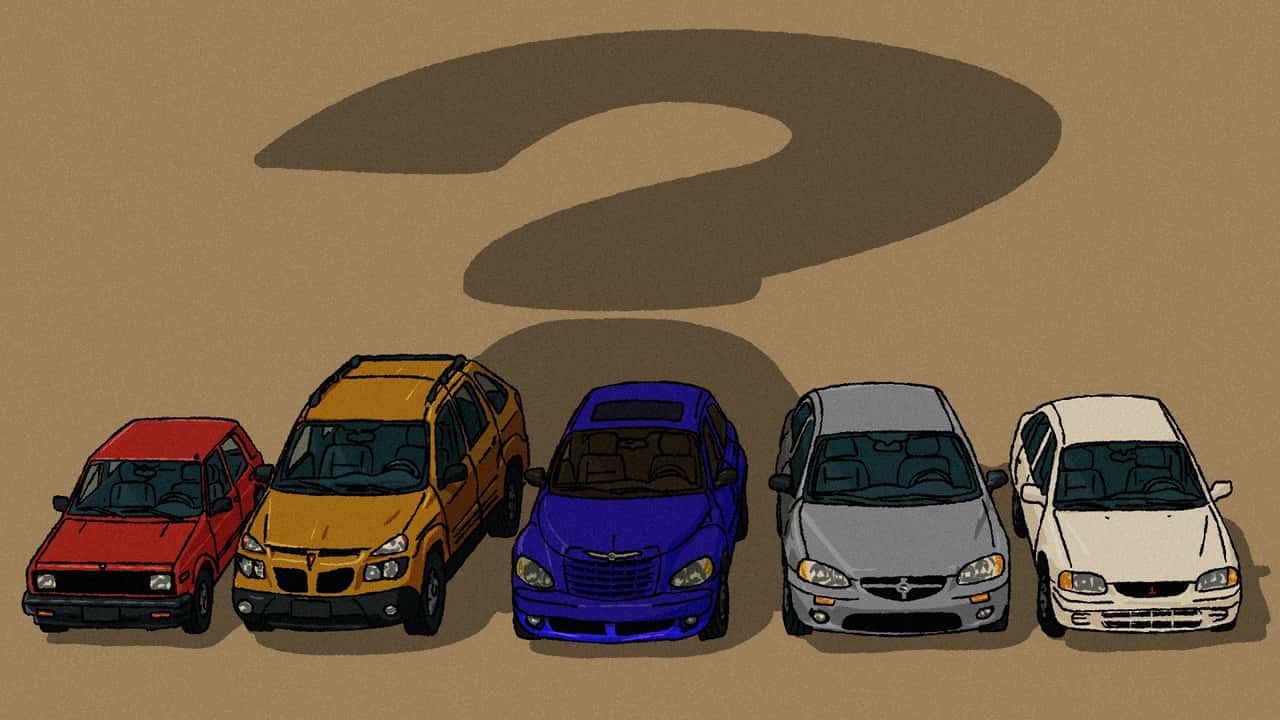
Photo by: Sam Woolley | Motor1
Zander Sutton 
By: Zander Sutton
Nov 16, at 9:30am ET
Add Motor1.com as a preferred source in Google
- (https://twitter.com/intent/tweet?url=https%3A%2F%2Fwww.motor1.com%2Ffeatures%2F815466%2Fwhere-did-bad-cars-go%2F&text=Where%20Did%20All%20The%20Bad%20Cars%20Go%3F&via=motor1com)
- copy
Share
Comment
In July, I spent a week with the Volvo EX30. The night before I had to give it back, my mom asked me something I hadn't really considered: Was the EX30 a bad car?
"Well, yeah," I thought to myself. Why wouldn't it be? It's an overpriced, inefficient EV with glitchy software. Surely, not a good car.
The more I thought about it, though, the less convinced I was. When you think of bad cars, you probably think of the Yugo, the Ford Pinto, or any number of forgettable economy cars from the 1970s and 1980s. Frankly, I'd rather drive an EX30 than a Yugo. In fact, I'd rather drive an EX30 than most historically bad cars.
But that led me to a more interesting question: What happened to all the bad cars?

Pontiac Aztek
Photo by: Pontiac
Bad cars used to be everywhere. The Cadillac Catera, for example, was a bad car. I can't imagine many people outside of Bob Lutz would argue otherwise. Models like the Catera existed by the thousands between the 1970s and early 2000s, when the automotive industry was seemingly at its peak for genuinely terrible vehicles.
Sure, some of these cars had their saving graces. The Geo Metro survived more than a decade in the US, for chrissake—somebody must have liked it. But try coming up with a modern equivalent that deserves the same reputation. It's surprisingly difficult.
"Bad" is, of course, subjective. If you don't like EVs, anything with a battery is bad. If you only like BMWs, anything with stars or four rings on the hood is probably terrible. But those aren't necessarily bad cars. They're just cars you don't like.
A genuinely bad car is something else entirely. No redeeming features. No saving graces. Nothing that makes you think, "Well, at least it does this one thing right."
By that definition, is it even possible to come up with a list, hell, even a handful, of genuinely bad cars in the year of our Lord 2026?
Models like the Catera existed by the hundreds between the 1970s and early 2000s, when the automotive industry seemed to reach its peak for producing genuinely terrible vehicles.
Now, I know what you're thinking: "What about that crossover? You know, the one with the tiny engine, cramped interior, and just-okay fuel economy?" Well, I hate to break it to you, pal, but whatever crossover you just pictured is probably fine. Borderline good, even.
Sure, we currently live in an epidemic of boring automobiles, but that's a column for another time. Boring and bad are two different things, and mundane shouldn't be punished for being anything more than mundane.
Nobody buys a Nissan Kicks for the driving experience. They buy it because the price is right, the features are there, and the warranty is acceptable. It's certainly not the sort of argument an enthusiast would make, but it's hard to argue that most modern crossovers suck when so many of them are perfectly competent at doing exactly what they're supposed to do.
They're comfortable enough, reasonably efficient, relatively safe, and generally easy to live with. They might not inspire much excitement, but they also don't give their owners many reasons to complain.
Nissan Kicks Rock Creek
Photo by: Nissan
Then there are EVs.
As I mentioned earlier, if you don't like electric cars, nothing here is going to change your mind. And that's fine. But hear me out: Most EVs are, at the very least, fine. Some are even very good.
The Mercedes EQS is ugly, but its range is excellent, and it rides beautifully. The Dodge Charger Daytona is a hilariously overpriced misfire, but it still has decent power and a considerably better cabin than the outgoing model.
That doesn't mean every EV is good. I'm still not entirely sure what the Fiat 500e is trying to accomplish—but even it gets a few things right. These aren't necessarily cars I'd recommend to everyone. But being overpriced, unattractive, or hopelessly niche doesn't automatically make something bad.
But hear me out: Most EVs are, at the very least, fine. Some are even very good.
Identifying a lack of bad cars is one thing. Explaining why they've seemingly disappeared is another.
Safety regulations are probably the biggest reason cars like the Chevrolet Chevette and Ford Pinto aren’t around today. Automakers have considerably less room to cut corners when it comes to building a fundamentally safe vehicle. Federal requirements, along with decades of improvements in crash engineering, have raised the minimum standard for practically every new car sold in the US.
And there's some compelling evidence to support just how much of a difference that has made.
According to the National Highway Traffic Safety Administration, federal vehicle safety standards prevented more than 860,000 deaths and 49 million nonfatal injuries between 1968 and 2019. That's an enormous number of lives saved simply by making certain safety technologies mandatory.
Think about how much has changed. Seat belts, airbags, electronic stability control, rearview cameras, and increasingly sophisticated crash structures are now part of the baseline for new vehicles. Gone are the days when a single airbag and optional anti-lock brakes were considered acceptable equipment.
Ford Pinto
Photo by: Ford
Even the cheapest cars on sale today have to meet crashworthiness and safety requirements that would have been unthinkable a few decades ago. Manufacturers can't simply build a dangerously compromised vehicle and sell it to someone looking for the lowest possible price.
And as much as we love a mildly dangerous car, one that can kill you because its manufacturer cut too many corners is a different story entirely.
Of course, regulations aren't the only reason cars have improved. Manufacturers have also gotten considerably better at engineering, testing, and building vehicles. But it's difficult to overstate how much mandatory safety standards have raised the floor of the entire industry.
Even the cheapest cars on sale today have to meet crashworthiness and safety requirements that would have been unthinkable a few decades ago.
Another factor is that cars have just gotten more expensive, particularly over the last several years.
With buyers being asked to spend more money, they're also expecting more from the vehicles they purchase. Automakers have increasingly had to pay attention to the overall ownership experience, even at the bottom end of the market.
The average transaction price for a new vehicle was around $37,000 in 2019. By 2025, it had climbed past $48,000. Now it’s over $51,000 mark for the first time.
Much of that increase was driven by Covid-era supply shortages, higher production costs, and automakers prioritizing more profitable trucks and SUVs over cheaper entry-level cars. The pandemic also showed manufacturers that they could sell fewer vehicles while focusing on more expensive, higher-margin models.
That initially made inexpensive cars even harder to find. But it also changed what consumers expected when they finally did buy something new.
If you're spending $30,000 on a compact car, you probably don't want it to feel like a $15,000 economy car. You want a decent interior, a usable infotainment system, comfortable seats, and enough technology to make you feel like you're getting your money's worth.
2027 Nissan Sentra
Photo by: Nissan
There's some evidence that manufacturers are delivering, too.
According to JD Power's 2026 Automotive Performance, Execution and Layout (APEAL) Study, the satisfaction gap between mainstream and luxury automakers has narrowed from 66 points in 2008 to just 29 points today.
Mainstream brands have gotten considerably better at delivering the things buyers interact with every day, from infotainment and interior design to comfort and convenience. In other words, the experience of owning a mainstream vehicle has gotten closer to that of owning a luxury car.
That's not to say a $25,000 economy car is suddenly a luxury vehicle. It isn't. But buyers have come to expect considerably more from even the cheapest cars on the market, and automakers have had to respond.
Technology has also gotten cheaper and easier to implement. Features that once separated expensive cars from inexpensive ones have gradually trickled down into the mainstream. A backup camera in a 1996 economy car would have been practically unthinkable. Today, it's federally required on new light vehicles.
Mainstream brands have gotten considerably better at delivering the things buyers interact with every day, from infotainment and interior design to comfort and convenience.
The result is that it's become considerably harder for manufacturers to produce the same sort of automotive filth they were getting away with 20 or 30 years ago.
Look, there are still some bad cars on sale today. I still think the Volvo EX30 is a bad car, and it's certainly not the only one. I'd rather drive it than a Cimarron or a Ford Aspire, but that doesn't make it good.
And this isn't an exercise in pretending every new car deserves a participation trophy. A great chassis doesn't excuse the Honda Prelude from being too expensive. A decent electric powertrain doesn't make the Mercedes EQS any prettier. And no amount of technology can fix a car that fundamentally misses the mark for its intended audience.
Volvo EX30
Photo by: Volvo
But we're so far removed from the days of truly reprehensible new cars that it's worth appreciating how much the industry has improved.
Automakers can't simply slap together a cheap car, ignore basic safety, and hope consumers won't notice. Buyers expect more, regulations demand more, and manufacturers have become considerably better at delivering it.
What do you think?
View
Comments
We might be living through an epidemic of automotive boredom, but that's a much better problem to have than an epidemic of genuinely terrible cars. No amount of ugly Mercedes AMGs or electric Porsches can, or should, be compared to the cars we used to get. And for that, we should probably be thankful.
Just ignore the VinFast VF8.
More From State Of Motion
The Corvette Spent 70 Years Building Its Legacy. There's No Reason To Dilute It Now
Mid-Size Trucks Are Booming. Now Everyone Wants In
America Didn't Give Up On Wagons. Car Companies Did
Speed Limits Are Going Up Across The US. So Are Deadly Crashes
We want your opinion!
What would you like to see on Motor1.com?
Take our 3 minute survey.
- The Motor1.com Team
Share this Story
- (https://twitter.com/intent/tweet?url=https%3A%2F%2Fwww.motor1.com%2Ffeatures%2F815466%2Fwhere-did-bad-cars-go%2F&text=Where%20Did%20All%20The%20Bad%20Cars%20Go%3F&via=motor1com)
- copy
GO TO COMMENTS
(
)
Got a tip for us? Email: tips@motor1.com
View all comments ( )
Popular
Toyota's Cheaper Sports Car Is Reportedly Back On The Menu
Where Did All The Bad Cars Go?
The Subaru WRX STI Sport R Brings Back A Beefy Manual Gearbox
BMW Isn't Saying No To More Physical Controls, But It's Not Saying Yes Either
The Average Bugatti Buyer Is Just 42 Years Old. One Customer Owns 14 Of Them
Latest Stories
- GTA 6 Has Already Made $1.18 Billion. It's Not Even Out Yet Nov 16 - Video games -
- Where Did All The Bad Cars Go? Nov 16 - State of Motion -
- I Tried Mercedes' New Hands-Free Driving Tech. It Nearly Drove Me Everywhere Nov 16 - New Car Reviews -
- F1 Car, MotoGP Bike, Rally Car And Snowmobile Face Off On A Frozen Lake Nov 16 - Races and Chases -
- BMW Recalls 720,000 Vehicles For Water Pump Fire Risk. Owners Told To Park Outside Nov 16 - Recalls -
- There's A Reason Your Car Door Doesn't Close Properly Anymore Nov 16 - Motor101 -
- The Average Bugatti Buyer Is Just 42 Years Old. One Customer Owns 14 Of Them Nov 16 - Supercars -
RECOMMENDED FOR YOU
The Corvette Spent 70 Years Building Its Legacy. There's No Reason To Dilute It Now
GTA 6 Has Already Made $1.18 Billion. It's Not Even Out Yet
Mitsubishi Needs The Montero Back In America. Now More Than Ever
I Tried Mercedes' New Hands-Free Driving Tech. It Nearly Drove Me Everywhere
Volkswagen's Seat Brand Deserved Better
F1 Car, MotoGP Bike, Rally Car And Snowmobile Face Off On A Frozen Lake
Mazda Isn't Rushing Its Next Models. That's A Good Thing