Home
Features
Motor101
Not All Gas Engines Work The Same. Here's What Makes Them Different
Otto, Atkinson, and Miller engines all burn fuel differently. Here’s how their designs affect power, efficiency, and everyday driving.

Photo by: BMW
Dan Mihalascu 
By: Dan Mihalascu
Nov 12, at 3:00pm ET
Add Motor1.com as a preferred source in Google
- (https://twitter.com/intent/tweet?url=https%3A%2F%2Fwww.motor1.com%2Ffeatures%2F815104%2Fotto-vs-atkinson-vs-miller-cycle-engines%2F&text=Not%20All%20Gas%20Engines%20Work%20The%20Same.%20Here%27s%20What%20Makes%20Them%20Different&via=motor1com)
- copy
Share
Comment
They all use gasoline and pistons, but these three engine cycles take different approaches to power, efficiency, and fuel economy. Most gasoline engines follow the Otto cycle, a combustion process that has powered cars for more than a century. However, not every internal combustion engine operates in exactly the same way.
Some manufacturers use variations such as the Atkinson and Miller cycles to improve efficiency, reduce fuel consumption, or extract more useful work from every drop of gasoline. Although these three engine cycles share the same basic four-stroke principle, they differ in how they manage the intake charge, compression, and expansion of gases inside the cylinders. Here's what separates them.
The Otto Cycle: The Traditional Way Of Making Power
The Otto cycle is the foundation of most conventional gasoline engines. Named after German engineer Nikolaus Otto, who developed the four-stroke engine in the 19th century, it describes how an engine draws in an air-fuel mixture, compresses it, ignites it, and expels the resulting exhaust gases.
The process involves four distinct strokes: intake, compression, power, and exhaust. During the intake stroke, the piston moves downward, drawing air into the cylinder. The piston then moves upward to compress the mixture, which is ignited by the spark plug near the top of the compression stroke.
The resulting combustion pushes the piston downward, turning the crankshaft and producing power. Finally, the exhaust valve opens, allowing the spent gases to escape.
What makes the Otto cycle different from the other two is that its compression and expansion ratios are essentially equal in the ideal thermodynamic model. In practical engines, valve timing and other factors influence the effective ratios, but the basic principle remains the same.
The Otto cycle prioritizes a balance of power, responsiveness, and efficiency. It's widely used in everything from small city cars to high-performance sports cars because it offers predictable power delivery without requiring particularly complicated engine hardware.
The Atkinson Cycle: Sacrificing Power For Better Efficiency
The Atkinson cycle takes a different approach. Instead of trying to extract as much power as possible from every combustion event, it focuses on getting more useful energy out of the fuel that's burned.
The original Atkinson engine, patented by British engineer James Atkinson in 1882, used a complicated mechanical linkage to create different effective compression and expansion strokes. The expansion stroke was longer than the compression stroke, allowing the combustion gases to push the piston for longer and extract more energy before leaving through the exhaust.
Modern Atkinson-cycle engines achieve a similar result through variable valve timing. Rather than using an elaborate mechanical arrangement, they typically keep the intake valve open longer than a conventional Otto-cycle engine. As the piston begins moving upward during compression, some of the air-fuel mixture is pushed back into the intake manifold. This reduces the effective compression ratio while retaining a relatively high expansion ratio.
The advantage is improved thermal efficiency because the engine extracts more useful work from the expanding gases. The downside is that less air enters the cylinder, which generally limits the engine's power output for a given displacement.
That's why Atkinson-cycle engines are particularly popular in hybrid vehicles. Toyota and Honda, for example, use versions of this technology in several of their hybrid powertrains. An electric motor compensates for the gasoline engine's reduced low-speed torque, allowing the overall system to deliver responsive acceleration without sacrificing fuel economy.
The Miller Cycle: Efficiency Without Giving Up As Much Power
The Miller cycle is closely related to the modern Atkinson cycle, but there's an important distinction: it was developed to improve engine efficiency while using forced induction to help maintain power.
Named after American engineer Ralph Miller, who patented the concept in 1957, the Miller cycle uses altered intake-valve timing to reduce the effective compression ratio while maintaining a higher expansion ratio. This helps the engine extract more energy from combustion rather than allowing as much of it to escape through the exhaust.
The main challenge is that reducing the effective compression ratio also reduces the amount of air trapped inside the cylinder. That's where a supercharger or turbocharger comes into play. By forcing more air into the engine, the system can compensate for the reduced cylinder filling and help maintain power output.
Miller-cycle engines can use either early or late intake-valve closing, depending on the design. Both approaches can reduce effective compression, although they achieve it in different ways. One of the best-known production applications was Mazda's KJ-ZEM 2.3-liter V6 engine, used in the Mazda Millenia. It combined Miller-cycle operation with a Lysholm-type supercharger to improve efficiency without giving up the performance expected from a V6.
The result is an interesting middle ground: a design that seeks some of the efficiency benefits associated with the Atkinson cycle while using forced induction to address its power limitations, as this technical explanation from IHI Corporation notes.
Atkinson Vs. Miller Vs. Otto: What's The Difference?
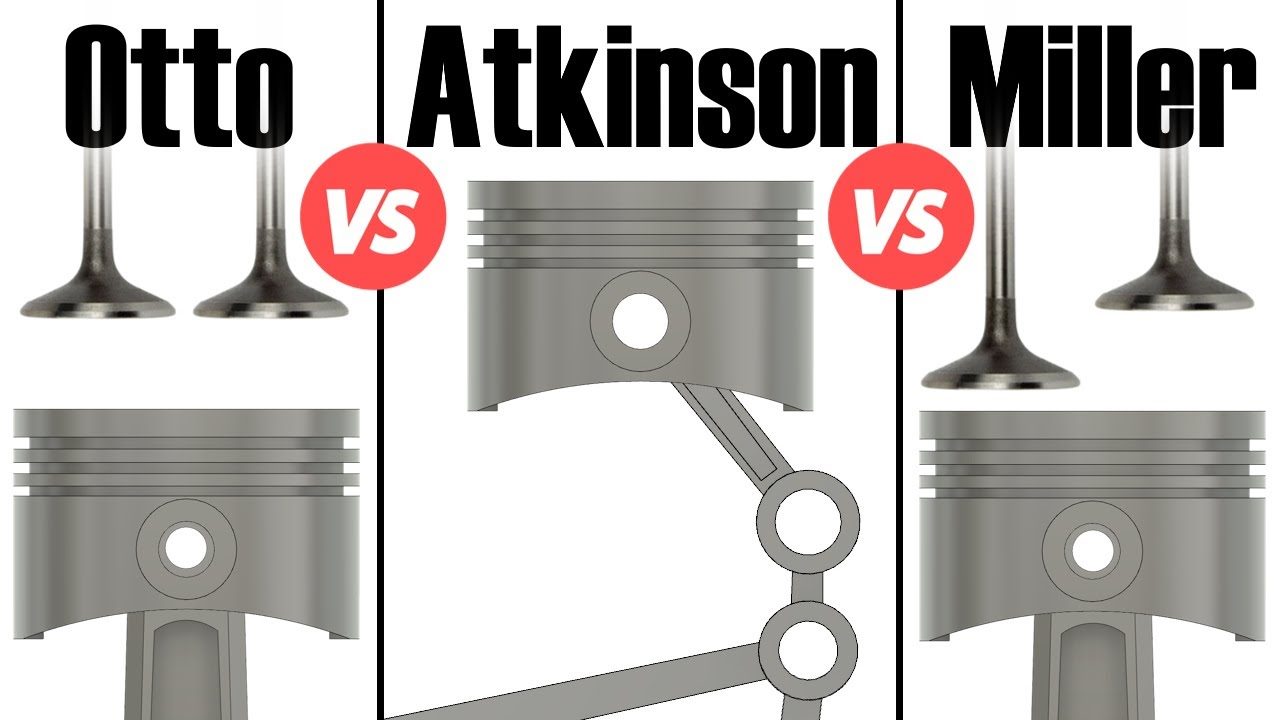
Although all three cycles use the same basic four-stroke process in their modern automotive applications, they differ in how they handle compression, expansion, and the amount of air entering the cylinders. Here's a quick breakdown:
- Otto cycle: Uses essentially equal compression and expansion ratios in the ideal cycle. It's designed to deliver a balanced combination of power and efficiency.
- Atkinson cycle: Uses a lower effective compression ratio and a higher expansion ratio to extract more useful energy from combustion. It's particularly popular in naturally aspirated hybrid engines.
- Miller cycle: Also uses a reduced effective compression ratio and a higher expansion ratio, but typically combines altered valve timing with turbocharging or supercharging to maintain power.
The differences also become apparent when looking at the applications. Otto-cycle engines are common in conventional gasoline-powered vehicles, while Atkinson-cycle engines are frequently found in hybrids. Miller-cycle engines have been used in applications where manufacturers want to combine improved efficiency with stronger power output.
It's worth noting that the distinction between modern Atkinson and Miller engines is not always clear-cut. Both can use similar valve-timing strategies, and some manufacturers use the names differently. The presence of forced induction is a useful distinction, but the actual engine design matters more than the label.
What Do Drivers Think About Atkinson, Miller, And Otto Engines?
Reddit discussions suggest that the Atkinson cycle's biggest appeal is fuel efficiency, although some enthusiasts question whether its reduced power output makes it suitable for every application. In a discussion on r/Toyota, users pointed out that Otto-cycle engines generally deliver more power for a given displacement, while Atkinson-cycle designs prioritize efficiency. Several also highlighted how hybrid systems compensate for the Atkinson engine's weaker low-speed performance.
Another interesting discussion on r/AutomotiveEngineering explores why automakers don't simply replace conventional gasoline engines with Atkinson-cycle alternatives. The responses touch on power density, engine size, weight, and the fact that efficiency gains aren't necessarily the same across every operating condition.
There's also an interesting technical discussion on r/AutomotiveEngineering about how modern engines can switch between Atkinson-like and Otto-like operation using variable valve timing. This highlights an important point: the three cycles aren't always completely separate categories in modern automotive engineering.
Which Engine Cycle Is Better?
There is no clear winner because each cycle is designed around different priorities. The Otto cycle remains a popular choice because of its versatility and ability to deliver strong power across a wide range of applications. It's particularly suitable for drivers who want conventional performance without the added complexity of a hybrid system or specialized forced-induction setup.
The Atkinson cycle makes more sense when fuel efficiency is the priority. Its reduced power output can be a disadvantage in a conventional vehicle, but pairing it with an electric motor makes that compromise much easier to manage. That's why it's become such an important part of modern hybrid technology.
What do you think?
View
Comments
The Miller cycle, meanwhile, offers another way to improve thermal efficiency while retaining more power through forced induction. It's not necessarily better than the Atkinson cycle, but it gives engineers another tool when designing engines that need to balance efficiency and performance.
Ultimately, the Otto, Atkinson, and Miller cycles demonstrate that there's more than one way to make a gasoline engine work efficiently. The Otto cycle prioritizes balanced performance, the Atkinson cycle focuses on extracting more energy from fuel, and the Miller cycle uses a combination of altered valve timing and forced induction to pursue efficiency without giving up as much power.
More From Motor101
 There's A Reason Your Brain Doesn't Like Driving A CVT
Paint Protection Film Costs Thousands. Is It Actually Worth It?
The Physics Behind Why SUVs Are More Likely To Roll Over In A Crash
No, Premium Gas Doesn't Automatically Make Your Car Faster
We want your opinion!
What would you like to see on Motor1.com?
Take our 3 minute survey.
- The Motor1.com Team
Share this Story
- (https://twitter.com/intent/tweet?url=https%3A%2F%2Fwww.motor1.com%2Ffeatures%2F815104%2Fotto-vs-atkinson-vs-miller-cycle-engines%2F&text=Not%20All%20Gas%20Engines%20Work%20The%20Same.%20Here%27s%20What%20Makes%20Them%20Different&via=motor1com)
- copy
GO TO COMMENTS
(
)
Got a tip for us? Email: tips@motor1.com
View all comments ( )
Popular
12 Crossovers That Are Surprisingly Good At Off-Roading
Scout Has 212,000 Reservations. Here's What Those Drivers Own
Subaru Wants To Save The Gas Engine With A More Efficient Boxer
Honda Secretly Showed Dealers Its Future Models, Including The Element. Here's What They Said
Scout Is Finally Building Real Vehicles At Its $2-Billion Factory
Latest Stories
- Not All Gas Engines Work The Same. Here's What Makes Them Different Nov 12 - Motor101 -
- Scout Has 212,000 Reservations. Here's What Those Drivers Own Nov 12 - Manufacturing / Production -
- Want A New Pickup With A Manual? There's Still Only One Choice Nov 12 - Manufacturing / Production -
- The Corvette Spent 70 Years Building Its Legacy. There's No Reason To Dilute It Now Nov 12 - State of Motion -
- Don't Buy A Blackwing. This 640-HP Cadillac Costs Thousands Less Nov 12 - Why Buy? -
- Next Honda CR-V Is Going Hybrid-Only. Here's The First Teaser Nov 12 - Teasers -
- Nearly 37,000 Lincoln Navigators Recalled Over Phantom Passenger Seat Movement Nov 12 - Recalls -
RECOMMENDED FOR YOU
The Worst Car Communism Gave The World: The Trabant
Scout Has 212,000 Reservations. Here's What Those Drivers Own
This Gearbox Blurs The Line Between Manual And Automatic
Want A New Pickup With A Manual? There's Still Only One Choice
Your Car Has Airbags In Places You Probably Didn't Even Know
The Corvette Spent 70 Years Building Its Legacy. There's No Reason To Dilute It Now
Paint Protection Film Costs Thousands. Is It Actually Worth It?