Home
BMW
Features
Why Does BMW's Headquarters Look Like That?
You've probably never considered it, but there's a reason BMW's headquarters in Munich looks the way it does.
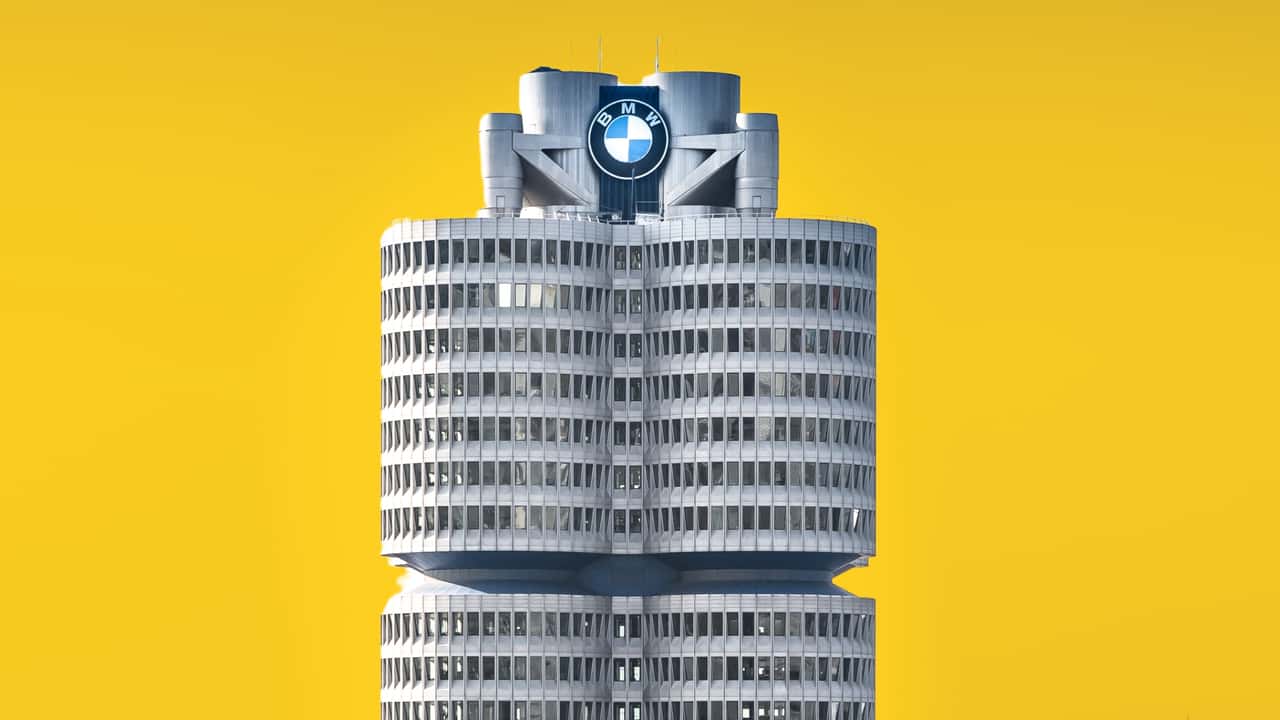
Photo by: BMW
Jeff Perez 
By: Jeff Perez
Jul 17, at 9:00am ET
Add Motor1.com as a preferred source in Google
- (https://twitter.com/intent/tweet?url=https%3A%2F%2Fwww.motor1.com%2Ffeatures%2F800899%2Fwho-designed-bmw-headquarters%2F&text=Why%20Does%20BMW%27s%20Headquarters%20Look%20Like%20That%3F&via=motor1com)
- copy
Share
Comment
If you’ve ever wandered through the streets of Munich, you’ve probably noticed the massive cylindrical towers looming over downtown. While it may look like the headquarters of some evil empire destined to take down James Bond once and for all, it’s actually where some of the best performance cars on the planet come to life.
The BMW Tower—appropriately nicknamed 'Vierzylinder'—has stood over Munich for more than 50 years. Serving as the global headquarters for BMW Group since 1973, it's one of Germany's most recognizable corporate buildings and an architectural landmark beloved by auto enthusiasts and design nerds alike.
Naturally, the unusual shape raises an obvious question: Why was it designed that way? As it turns out, the answer is rooted in BMW's engineering identity.
MOTOR101
Welcome to Motor101, our series dedicated to answering the internet's biggest automotive questions. From the origins of iconic designs to the engineering breakthroughs that shaped the world's greatest cars, we uncover the stories behind the vehicles you love.
How BMW's Iconic Headquarters Happened

Austrian Architect Karl Schwanzer
Photo by: Karl Schwanzer Archive
The early 1970s were a transformative time for Munich. The city was preparing to host the 1972 Summer Olympics, and officials wanted to showcase a bold, modern vision of Germany to millions of visitors from around the world.
The plan centered around a brand-new Olympic Park, with BMW's headquarters serving as one of its defining landmarks. Architectural firm Behnisch & Partner designed the Olympic Park, while Austrian architect Karl Schwanzer was commissioned to create BMW's new headquarters.
BMW Tower Under Construction
Photos by: BMW
BMW Tower Under Construction
Photos by: BMW
Schwanzer drew inspiration from the work of Brazilian architect Oscar Niemeyer, whose sweeping modernist buildings helped define the new capital city of Brasília in the late 1950s and early 1960s. Rather than designing a conventional office tower, though, Schwanzer envisioned something that reflected BMW's engineering heritage.
His idea was simple: Build a skyscraper that resembled the four cylinders of an engine.
The 'Engine Block' Design
Photo by: BMW
From a design standpoint, the "engine block" concept wasn’t just for looks. The building consists of four interconnected cylindrical towers, each representing an engine cylinder and functioning as its own structural core. Office spaces are suspended around those cores rather than supported from below—an innovative idea for the time.
Instead of being built floor by floor from the ground up, many of the office floors were actually assembled at ground level and then lifted into place using hydraulic jacks before being attached to the central support structure. The construction method was considered groundbreaking in the early 1970s and helped create the tower's distinctive look.
Inside The BMW Tower
Photos by: BMW
Inside The BMW Tower
Photos by: BMW
Standing approximately 99.5 meters (326 feet) tall with 22 occupied floors, the BMW Tower was completed in 1972 and officially opened the following year. Although it no longer ranks among Germany's tallest skyscrapers, its silhouette remains one of the country's most recognizable.
One of the building's most striking features is its base. Rather than appearing to rest on the ground like a traditional office tower, the structure seemingly hovers above its foundation. That floating effect was entirely intentional, emphasizing lightness, precision, and technical innovation—the same qualities BMW wanted people to associate with its cars.
In an internal memo from 1973, BMW said of its new headquarters:
'The biggest four-cylinder in the world—a landmark for the city of Munich alongside the Olympic Park. Ergonomically compact inside and clearly contoured outside, it is a boldly conceived experiment and a milestone in the history of architecture. BMW has created space for its expanding business with an administrative centre of the New Class.'
What do you think?
View
Comments
Still An Icon Today
Photo by: BMW
Next door sits the iconic BMW Museum, whose circular shape earned it the nickname "the salad bowl," while the futuristic BMW Welt opened in 2007 as the brand's customer delivery and exhibition center. Together, the three buildings form one of the world's most recognizable automotive campuses.
More than half a century after its debut, the BMW Tower still looks futuristic. And while BMW has evolved from building compact four-cylinder sedans to high-performance M cars and electric SUVs, its headquarters remains a permanent reminder that engineering has always been at the heart of the brand.
More From Motor101
The Three Types Of Automatic Transmissions—And How They Actually Work
Why Some Cars Put Power Down Better Than Others
AWD Vs 4WD: What's the Difference And Which One Do You Need?
Every Chevrolet Corvette Generation, Explained
We want your opinion!
What would you like to see on Motor1.com?
Take our 3 minute survey.
- The Motor1.com Team
Share this Story
- (https://twitter.com/intent/tweet?url=https%3A%2F%2Fwww.motor1.com%2Ffeatures%2F800899%2Fwho-designed-bmw-headquarters%2F&text=Why%20Does%20BMW%27s%20Headquarters%20Look%20Like%20That%3F&via=motor1com)
- copy
GO TO COMMENTS
(
)
Got a tip for us? Email: tips@motor1.com
View all comments ( )
Popular
Bugatti Restores One-Off Veyron With A Mirror-Like Aluminum Body
BMW Kept This Hatchback A Secret For Decades
Skoda Wants You To 3D Print Pieces Of Your Car At Home
The Gas BMW M3 Isn't Dead: Next-Gen Prototype Roars
latest articles
- The Ford Ranger Is Getting A Bigger V6 For 2027: Report Oct 20 - Rumors -
- BMW Already Has A Deal On The New i3. But It's Not Cheap Oct 20 - Pricing -
- Remember The Ford Flex? This Weird SUV Is Now A Great Used Buy Oct 20 - Why Buy? -
- Mercedes Isn't Sold On Extended-Range EVs: 'Would You Really Switch?' Oct 20 - Interview -
- Cadillac Driver Is Fed Up With Auto Stop. Then She Buys A $9 Item On Amazon To Disable It Oct 20 - Trending -
- Bugatti Restores One-Off Veyron With A Mirror-Like Aluminum Body Oct 20 - Supercars -
- Lexus NX Goes Hybrid Only For 2027 Oct 20 - Official -
RECOMMENDED FOR YOU
BMW Already Has A Deal On The New i3. But It's Not Cheap
The Ford Ranger Is Getting A Bigger V6 For 2027: Report
The Gas BMW M3 Isn't Dead: Next-Gen Prototype Roars
Remember The Ford Flex? This Weird SUV Is Now A Great Used Buy
BMW Is Reportedly Offering Employees Up To $730,000 To Leave The Company
Mercedes Isn't Sold On Extended-Range EVs: 'Would You Really Switch?'
BMW Kept This Hatchback A Secret For Decades